Care Without Boundaries: Survival Disguised as Commitment
Care is often celebrated as a strength, and it should be, but caring deeply does not mean caring without limits.
In advocacy work and leadership spaces, caring deeply is frequently viewed as evidence of commitment, compassion, and purpose. We praise people for going above and beyond, being available, carrying more, and never letting things drop.
But what happens when care exists without boundaries?
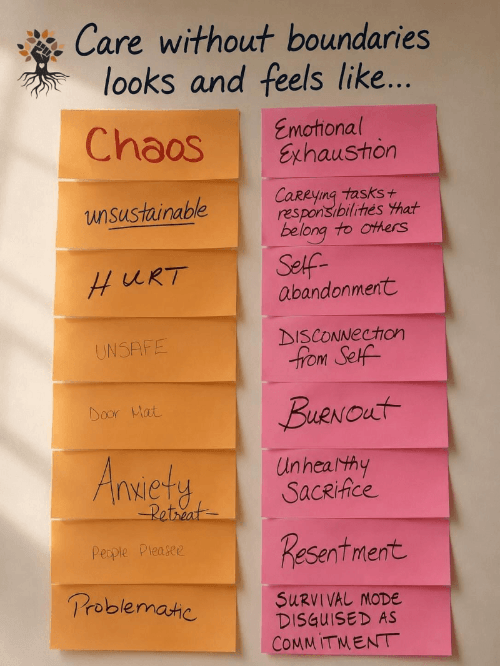
Recently, across multiple training spaces, participants were invited to reflect on the question:
“What does care without boundaries look or feel like?”
The responses were immediate and consistent, and ultimately inspired this piece.
We heard…
Burnout.
Overwhelming.
Lowered expectations.
Lack of hope.
Grey areas.
Unhealthy relationships.
Chaos.
Hurt.
Unsafe.
Doormat.
Anxiety… then retreat.
People pleasing.
Problematic.
Unsustainable.
One word surfaced repeatedly across groups:
Burnout.
Not because people stopped caring.
But because they cared without the conditions—without the boundaries—that protected their own humanity.
At TooREL Institute for Social Change, we often talk about the Four Ripples of Care as a way to think more expansively, and sustainably, about care.
One of our signature trainings: When Care Becomes the Work.
Care is not a single act. It ripples outward.
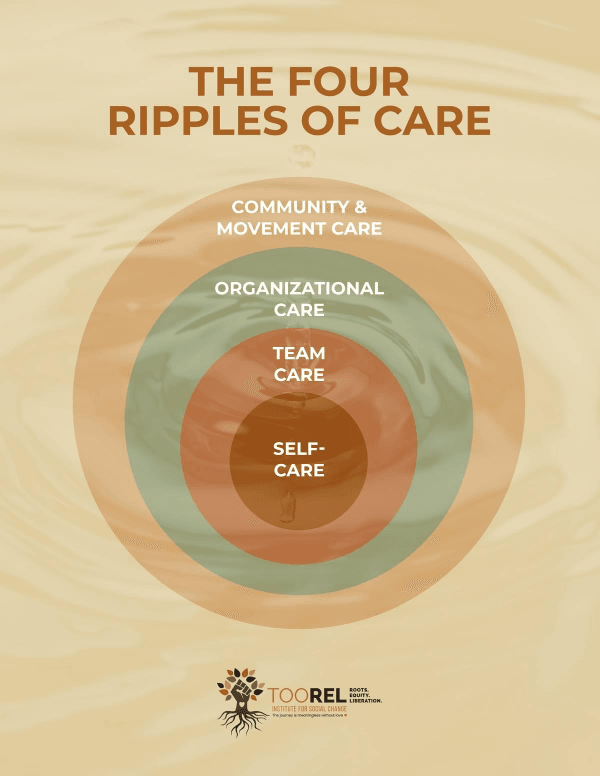
Ripple One: Self-Care
The first ripple asks:
How do I sustain myself in this work?
Care without boundaries often means our needs become negotiable while everyone else’s become urgent.
We overextend.
We override our limits.
We disconnect from our bodies, values, and capacity.
Over time, care becomes performance rather than practice.
This may look like:
saying yes when we mean no
neglecting rest and recovery
disconnecting from our needs and values
unhealthy sacrifice
emotional exhaustion
survival disguised as commitment
Self-care is not selfish.
"Caring for myself is not self-indulgence. It is self-preservation, and that is an act of political warfare." - Audre Lorde
Care begins with recognizing that we are also worthy of care.
Without boundaries, care can become one-directional—flowing outward while excluding self.
It is the practice of recognizing limits, honoring needs, and making intentional choices that support our well-being and our ability to remain in relationship with others.
Ripple Two: Team Care
How do we sustain each other as a team?
Healthy teams create shared responsibility rather than relying on a few people to absorb the weight.
Without boundaries, team care can become:
carrying responsibilities that belong to others
unclear expectations
lowered accountability
resentment
loss of trust and belonging
While self-care is important; collective care recognizes that individual well-being cannot be sustained in unhealthy systems and toxic environments.
Caring for ourselves should not replace creating team norms, practices, and relationships that distribute care, responsibility, and support.
Ripple Three: Organizational Care
How does our organization show care through daily practices and policies?
Organizations often say people matter but frequently prioritize products, productivity, urgency, and outcomes over people.
Organizational practices and policies can unintentionally dismiss care through unrealistic expectations, unsustainable workloads, unclear priorities, chronic urgency, and cultures that reward overextension.
Systems created to maximize output without regard for human capacity often normalize burnout and frame exhaustion as commitment.
Without boundaries, organizations may unintentionally reward:
over-functioning
people pleasing behaviors
constant availability
sacrifice disguised as dedication
When burnout becomes normalized, care has become performative.
Ripple Four: Community and Movement Care
How do we extend the ripple of care beyond organizations to the communities and broader movement?
Community reminds us that we do not do this work alone. Our relationships, networks, and shared responsibility shape whether people feel connected, supported, and able to remain in the work over time.
Movements are sustained by people, not extracted from them.
Say it with me—out loud:
Movements are sustained by people, not extracted from them.
Community and movement care asks:
How do we build environments and movements where we normalize, rest, recovery, healing, growth, shared responsibility — and remain connected over time?
Without boundaries, movements risk:
exhaustion and burnout
over-reliance on a few people or organizations
isolation and siloing
disengagement and shrinking participation
blurred roles and responsibilities
weakened collaboration and partnership
fractured relationships and community disconnection
competition over meaningful connection
transactional engagemens instead of shared purpose and investment
urgency replacing sustainability
Sustainability requires that care extend beyond immediate outcomes and include the well-being of the people doing the work, the people we co-labor with every day, recognizing that how we care for self and others shapes the strength of our communities and the future of our movements.
The Reframe
Boundaries are not barriers to care.
Boundaries are what make care sustainable.
Boundaries help us distinguish:
support from rescuing
commitment from over-functioning
accountability from over-responsibility
generosity from self-abandonment
And perhaps most importantly—
they protect us from survival disguised as commitment.
Care that lasts is rooted, reciprocal, normalized, and intentional.
Ask Yourself:
Where have I excluded myself from the circle of care?
Where in my life or work am I extending care without clear boundaries?
Which ripple currently needs the most attention: self-care, team care, organizational care, or community and movement care?
What responsibilities, emotions, or outcomes am I carrying that may not belong to me alone?
How do I know when my care is rooted in choice and values rather than guilt, fear, obligation, shame, or survival?
What have I mistaken for commitment that may actually be survival?
What expectations have I normalized that may be unsustainable?
What is one boundary, practice, or shift I can make that supports sustainable care, for myself and others?
Start today. Begin where you are.
Newly published resource to support this journey:
Rooted in Care: Self-Guided Workplace Culture Toolkit, Grounded in People First, Purpose Always™, created by Arlene Vassell, and now available at the TooREL Store and the Advocates Paying Advocates (APA) Marketplace.
Advocates Paying Advocates Marketplace:
TooREL Online Store:
https://www.toorelinstitute.org/store/products/rooted-in-care-self-guided-workplace-culture-toolkit